Showing posts with label Sandra Boynton. Show all posts

Thursday, January 12, 2012

Kid's Picks

I've mentioned before what an avid reader I am. My husband is much the same way. There isn't a room in our house that doesn't have a few books tucked away somewhere (whether they are supposed to be there or not). One of our biggest fears when deciding to start a family was that our daughter might not take to reading. So far, that fear seems to be wildly unfounded. She loves books, and they are as much her toys as the ponies and stuffed things and building blocks.

Once she started sleeping through the night, in her own room, I began the nightly ritual of reading to her before bed. While she was still super little, it was just to get her used to that as part of the nighttime routine, and for her to get used to me reading to her. So I would read children's books without pictures, classic books maybe a little above her age range, and she would usually drift off (or bounce around in her crib) while I did so. We have finally hit the point where she has started wanting to actively be part of this routine. She now wants to pick from her (large) selection of picture books at bedtime, bringing me several stories to read to her as she sits next to me and engages in the story.

So I thought for today's post I'd share with you her top five favorite bedtime books.

This book is just cool. It features a small mouse trying to find his dragon. He looks at a different dragon on each page, pointing out why it can't be his dragon. One's ears are too tufty, another's tongue is too fuzzy, and so on. The really nifty thing about this book is that for each dragon, you can actually feel the thing the mouse is pointing out. There's a little bit of fluff for the tufty ears and what feels like a piece of velcro for the fuzzy tongue. It's wholly wonderful. Of course, at the end the mouse finds his dragon, so there's even a happy ending. In addition to touching the different textures, we also like to have her find the mouse for us on each page to make it a little more interactive. Baby Girl has actually memorized this one. The other night, she "read" it to me. That was awesome. I also learned, thanks to some friends, that the publisher actually has made several of these books, with different animals and such (and in many cases different textures to explore as well). We just got That's Not My Dinosaur and I can't wait to see how she responds to it!

This one is pretty cute too. It features several different African animals and starts out with a silly question about that animal, with an illustration showing them acting it out. The illustration is on a flap, behind which we get another of the animal doing something it actually does. For example, the page with the title question shows the zebra flapping it's arms for all it's worth, trying to take off. The flap reveals, however, that while a zebra can't actually fly, it can use its stripes to help hide. I like that this book has an educational element about the animals depicted. For extra fun, we like to count the animals on each page.

This one is pretty straightforward. On each pair of pages it features an item with the word written next to it. The fun bit is that there is a flap on each set of pages behind which the two items are combined. So for example the page with frog and ball then show a frog sitting on a ball. Some of them are really silly, like the green beans in the sock or the egg wearing a scarf, but it is lots of fun. Baby Girl has most of the words down pretty well, and she has even started being able to put the combinations together (she really has "mouse rides in the wagon" down). She very much enjoys opening up the flap I think.

My husband and I are also both huge fans of Sandra Boynton, so of course we have a multitude of her books in Baby Girl's library. This one is by far her favorite though, I think. Basically it is just hippos singing the praises of their belly buttons (and balloons), which kids of course find endlessly amusing.

Another Boynton classic. This one has lots of fun illustrations and easily lends itself to serve as a lesson in counting. Plus, it is a fascinating treatise on the party habits of hippos (and one non-hippo guest).

Of course, she has many, many more books, but these are the five that see the heaviest rotation, both at bedtime and when she feels like "reading" to herself. I think our worries that she might not enjoy reading were all for naught. She does truly seem to take pleasure in looking at and touching and arranging books. She can spend hours going through our books as well as her own (our poor bookshelves will never be properly arranged again, I fear). I'm sure it doesn't hurt that she often sees me and my husband curled up reading. She understands that it is something we enjoy doing and therefore must be fun.

It also leads to super cute moments like these:


Reading time!
This was our family reunion in 2010. My husband was taking a break and catching up on his reading and Baby Girl wanted to join him. She very much wants to be like her daddy. As evidenced in this one:

Checking out Daddy's book.

This was earlier last year. She stumbled across her father's book and climbed up on the couch with it. No one else was around, I just happened to wander in and find her like this. It was an awesome moment in parenting.

How about you? What books do your young readers enjoy the most?

Friday, December 24, 2010

Sandra Boynton's Christmastime (Part Seven)

Conclusion
Coming Down From Christmas

"Wee fish ewe a mare egrets moose, wee fish ewe a mare egrets moose, wee fish ewe a mare egrets moose, panda hippo gnu deer!"  --Sandra Boynton

Boynton wraps up the ever delightful Christmastime by discussing the hard fact that once Christmas has come and gone, we are all left with a little bit of emptiness in our hearts.  The season is such an immersive one that we are all bound to feel a little bit bereft when it has ended.  But as always, Boynton has the solution to the problem she presents.  She suggests that with careful planning, and a bit of thinking ahead, you can easily make Christmas a season to be enjoyed for the duration and remembered fondly when gone, without that pang of regret.  Be careful when making your plans, however, because she feels that being overly prepared is as much the cause of post-Christmas letdown as not being prepared enough.  She advises that the three most common training errors leading up to Christmas are as follows:

Overtraining: Be careful not to wear yourself out when making your preparations and plans for Christmastime.  This is very easy to do and can lead to diminished enjoyment of the season overall, and not just an overwhelming sense of disappointment once Christmas is done.

Overreaching:  Likewise, keep your expectations simple and as realistic as possible, especially if you are the person in charge of Christmas in your household.  Quite often people are disappointed after Christmas because they have set themselves up to be so.  Remember to enjoy each moment as you are in it, and try not to be constantly looking ahead to what is yet to come, just in case it doesn't.

Peaking Too Soon:  The earlier you start "celebrating" Christmas, the longer you have to keep up your spirits, and the harder it becomes to sustain those happy Christmastime feelings.  Especially in the face of everyone else you may have to deal with day in and day out.  Wait as long as you can (without making yourself insane) to start the decorating and the shopping and the celebration, and you'll have a better chance of enjoying the season more than you would if you try to stretch it out.  Getting just the right amount of holiday cheer is the best way to feel relaxed and at peace once it passes you by.

She also cautions that no matter how much you enjoy the season, even the best of us are likely to watch Christmastime pass with at least a smidgen of relief.  And that's okay.  It is a crazy season, as fun as it can be, and it is probably a very good thing that it only comes once a year.  If you're still feeling blue when the tinsel is cleared and the presents are put away, just remind yourself, that it does, in fact, come once a year, which means next year you get to do it all over again!

And that finishes off Sandra Boynton's Christmastime.  I hope you have enjoyed reading these posts as much as I have enjoyed sharing my thoughts on my favorite holiday book with you.  If you stumble across a copy, or feel like venturing onto Amazon's Marketplace, I highly recommend picking it up.  It is a quick read and one sure to strike a note with each member of your family.  As I can attest, it is also an excellent book to grow up with, keeping the true spirit of the season alive while capturing all of the ups and down that inevitably accompany it.  My daughter will definitely be growing up with this book as a part of her holiday tradition, I can tell you that.

And with that, I bid you a very very Merry Christmas, my friends!  I hope you have a truly wonderful holiday.  See you back on Monday!

P.S.  Don't forget to check out the new installment of Gronk here! It is the first of a run of a few weeks of guest strips, actually, because the artist/writer Katie Cook just made a new human this past week (huzzah to her!), but it is still pretty cute.  Enjoy.


Thursday, December 23, 2010

Sandra Boynton's Christmastime (Part Six)

Chapter Five
Good Things to Eat

"Imagine, for example, an apparently civilized country where the natives keep Christmas by eating the heads of wild boars, by drinking from ceremonial vessels a warm ale-and-egg brew, and by setting fire to sweetened mounds of beef loin fat and flour!  And yet, for all that, the British are probably people just like us."  --Sandra Boynton

Well, this chapter certainly seems inevitable.   What kind of book about the traditions of Christmas doesn't mention food?  Not a good one, that's for sure.  As always, Boynton approaches her chapter on the edible goodies of the seasons with just the right balance of wry humor and useful and/or interesting information.  Eating and drinking are wrapped up inextricably in almost every other Christmas tradition practiced around the world.  Think to your own favorite memories of Christmas.  How many of them involve sitting around a dinner table with your family, or a gathered group chatting together with some sort of holiday drinks in hand?  Breakfast is a big part too, of course, and usually comes into play somehow with the ritual of opening presents.  Then, of course, there are all of the goodies that suddenly appear everywhere you go this time of year.  Schools and offices are flooded with yummy baked goods.  Food is just part of this season.

Boynton embraces this wholeheartedly. She provides several recipes (three different kinds of cookies, Wassail Punch, plum pudding, and a very special post-holidays recipe).  For each she gives a little bit of background on the dish and its role in the season, along with some amusing little anecdotes.  I was even inspired to give one of the recipes a try for the first time ever this year.  I opted for the Rolled Lemon Cookies (page 95).  I even went out and bought a rolling pin and pastry mat especially for the occasion (okay, well I've been meaning to get those for ages anyway, but this was as good an excuse as any to finally do it). 

Note the traditional Christmas Squirrel, Mom.

I think they came out pretty well, actually.  They were very light and fluffy, and like a basic sugar cookie with just a hint of lemon.  Before I decided to ice them I didn't think they were quite sweet enough, but with the icing they are perfect (I used a basic powdered sugar/butter/vanilla extract icing).  Hubby and Baby Girl both seem to like them as well.  I halved the recipe, and it yielded just about three dozen cookies.  I got around two dozen cut out with cookie cutters and then divided the rest up into little balls, which I am calling "Lemon Drops."  I think the full recipe, primarily using cookie cutters would give you about five dozen cookies.  So kudos to Boynton on an awesome recipe.  Maybe next year I'll get brave and try the Pfeffernusse.  Then again, maybe not.

"Traditionally, families leave out homemade cookies for Santa on Christmas Eve.  Some people leave him a whole fruitcake (see page 77), and his appreciation is such that he in turn leaves an identical cake under their tree."  --Sandra Boynton

I have to say, Boynton is definitely on to something here.  Even before I really started to get into doing a lot more baking again (I actually did bake quite a bit as a kid and teenager, but college killed the mojo until recently), around Christmastime I could always be counted on for at least a batch of cookies or a pineapple chess pie.  Yesterday, in addition to the lemon cookies, I made a few other goodies as well.


Oatmeal Raisin Cookies

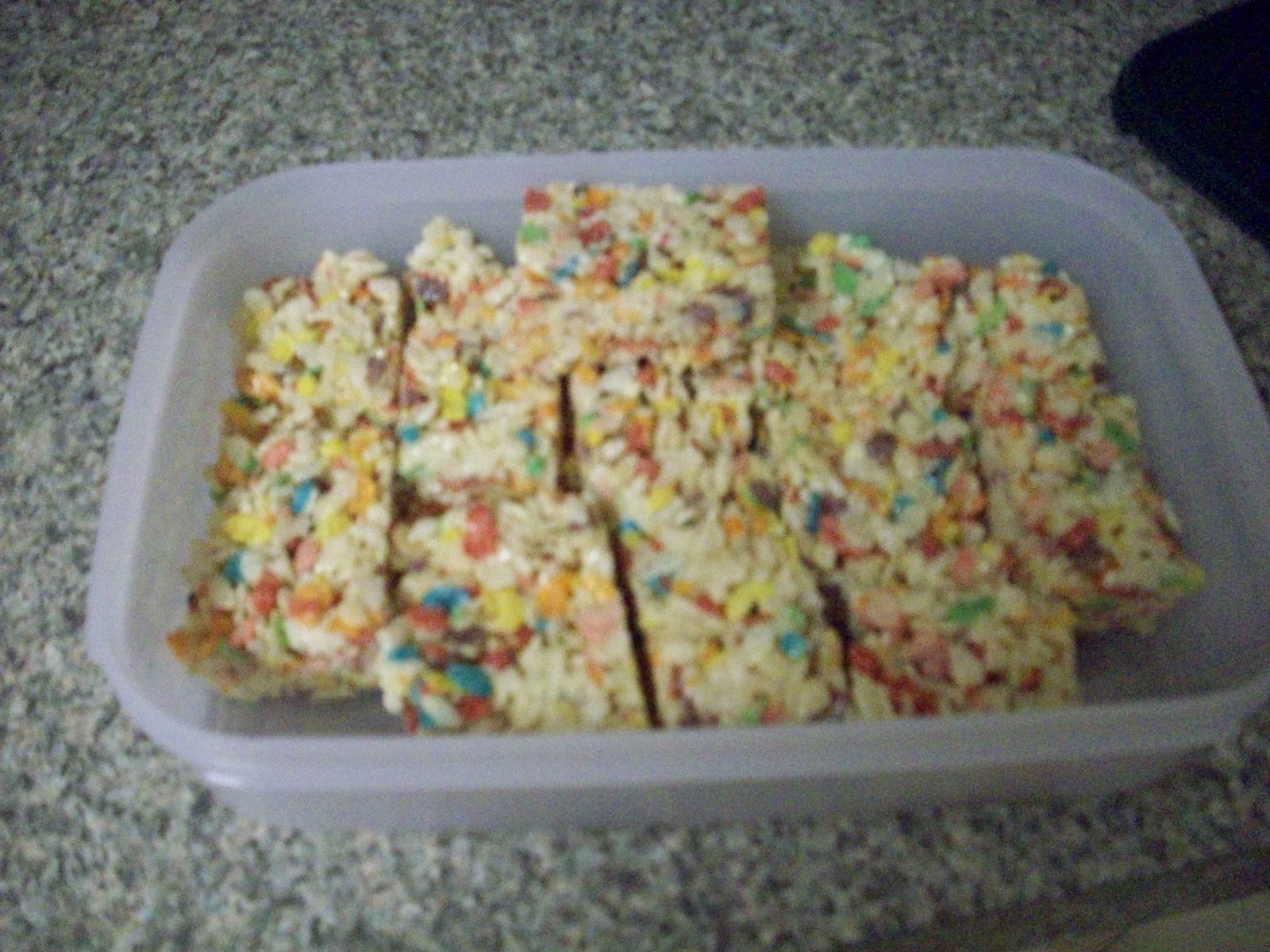
Fruity Rice Krispie Treats

The oatmeal cookies were the store-bought pre-cut "break apart and cook" dough kind, but, hey, I like those, and I figured now is as good a time as any to get them out of my freezer and in somebody's tummy.  The Rice Krispie treats have 2 parts Fruity Pebbles to 3 parts Rice Krispies.  It gives them a lot more flavor and a nice festive dash of color to boot.

Of course, as soon as Hubby got home, I gave him half of these goodies, all bagged up and ready to go to the office with him in the morning.  Just because I felt like making them doesn't mean I want to eat all of them.  Hmm.  We may need to try that special post-holidays recipe after all.  It's a pretty simple recipe, here, I'll share it with you:

Sandra Boynton's Karottenstickendietettisch

1.  Wash and peel:  24 carrots
2.  Slice lengthwise, and arrange appetizingly on a platter.

Bon appetit my friends!

Tomorrow:  Coming Down From Christmas

Wednesday, December 22, 2010

Sandra Boynton's Christmastime (Part Five)

Chapter Four
Christmas Traditions

 "A Christmas tradition is anything that happens every Christmastime, without fail."  --Sandra Boynton
Do you know that the true function of a fruitcake is?  (Hint:  It's not for eating.)  More on that in a bit.

In Chapter Four of Christmastime Boynton delves into a a few of the more widespread traditions of the season.  In her mind the most universal of these traditions is, of course, the gathering of family to celebrate together.  Christmastime certainly is a season that has sprung up and developed around being with loved ones.  There are few other times every year when people across the globe reach out to those members of their family that they don't get to see regularly, often even making the trek to visit and celebrate together in person.  Even in this day and age when travel has become such a huge pain in the rear (from expense to invasion of privacy to the risks involved just getting from point A to point B), this is still the time of year when most people are either going somewhere to see their family or entertaining visiting family in their own homes.

I will take a moment to point out that while I agree with Boynton wholeheartedly that Christmastime is a time for family, my husband and I actually aren't going anywhere this year for Christmas, nor are we entertaining any guests of our own.  It is Baby Girl's second Christmas, but the first when she might actually grasp what is going on, so we are looking forward to spending a quiet day at home with her, relaxing and being lazy and watching (or helping) her play with her new toys.  Also, new Doctor Who.  But this is not the norm for us.  We usually at the very least make a day trip into Mineral Wells to see the my husband's family, and sometimes we manage to work things out to visit my mom or dad.  As much as I look forward to having Christmas morning with just our small family unit, I will be missing my larger family quite a bit, I promise you that.  I am sure that in addition to all of that relaxing and playing, time will be made to call and chat with those we can't be with.  We will be making a day trip into Mineral Wells, of course, just a few days late this year.

Boynton next takes a few pages to discuss Santa Claus.  She gives a little of his back-story and describes the generally accepted version of the myth.  She points out that Orwell has got nothing on the lyrics to "Santa Claus Is Coming to Town," but yet somehow we all still view Saint Nick as a benevolent presence nonetheless.  She also acknowledges that there are plenty of people out there who do not believe (nor do they indulge in the belief of others) in the story of Santa Claus.  She further advises avoiding these people at all costs, because really, who wants that kind of unimaginative influence in their life?  (It is slightly possible that I just might concur on this point.)

Helpful Hints

To keep candycanes from becoming stuck to easy-chair cushions or embedded in your carpeting, either:
1.  DON'T BUY THEM or
2.  DON'T UNWRAP THEM or
3.  DON'T GIVE THEM TO CHILDREN

To enhance the beauty and extend the indoor life of your Christmas tree:  ADD 1/4 CUP SUGAR TO THE WATER IN THE TREE STAND  (Note:  Do not add saccharin, as this will cause your tree to turn to plastic.)

--Sandra Boynton

Boynton also turns her attention to a few other common Christmas traditions, such as stockings, Christmas music, and nativity sets.   She strikes a nice balance between the history behind the evolution of these traditions as well as their roles in modern Christmas celebrations.  This chapter is wonderfully entertaining as well as being just a little bit informative.  It reads a bit like a "history" lesson from your dad.  You know what I'm talking about, right?  You ask your dad why something is the way it is and he tells you what he knows (or thinks he knows) and then keeps on going until you stop him, just making it up off the top of his head.  I mean this in the best possible way.

Then, finally, we get to the fruitcakes.  Remember when I was introducing this series and I talked about my family's tradition of story time on Christmas Eve?  I said that whenever it was my turn to choose a story, I would read my favorite excerpt from Christmastime.  That excerpt comes from this chapter of the book, and is a brief little section titled "A Traditional Holiday Sport."  That sport is a fun little game Boynton describes called "Pass the Fruitcake."  In PtF, once a family has received a fruitcake, it is considered "in play," and the goal is to get rid of it as quickly as possible without eating it, throwing it away, or being discovered by the people who gave it to you in the first place.  I don't think there's any way I could do this section justice with a description, and there are many reasons why I can't just post the whole entry here, but if you ever stumble across a copy of this book, do yourself a favor and pick it up and flip to this section at the very least.  I dare you not to chuckle, or even laugh out loud.

I have to admit, I have never actually had fruitcake.  We were never invited to play the game, I guess.  But given the bad rap this treat gets in books and movies and on television, I kind of don't think I ever want to try it.  But at the same time, I am morbidly curious.  Is it something like green-bean casserole (which I love)?  Does it get a bad rap because it looks funny and has things in it that a lot people are just naturally averse to, despite them being awesome?  Is it something that is just really hard to make correctly, and thusly something that is really easy to make taste bad?  I dunno.  But every year I wonder, largely in part due to Sandra Boynton.

Tomorrow:  Good Things to Eat

Tuesday, December 21, 2010

Sandra Boynton's Christmastime (Part Four)

Chapter Three
Gift Giving

Yet Another Consumer Tip:  Before you place your gift order with any mail-order catalog company, make sure they have a policy of NO UNAUTHORIZED SUBSTITUTIONS. --Sandra Boynton

Boynton starts off her chapter on Christmas presents by declaring that the giving of those presents is truly one of the greatest joys of the season.  Of course, coming up with an idea for, and then procuring, each gift is another matter entirely.  As is actually affording those great gifts you stumble across.  In the current economy I think it is definitely fair to say that the truth still rings clearly in that idea.

I have said before that I am amazed at how relevant this book has managed to stay over the past twenty-three years, while still containing a few glaringly dated snapshots of the general mindset in the eighties.  This chapter is an excellent example of both concepts, to be sure.

Much like in Chapter Two, where Boynton discusses sending cards out of obligation as opposed to genuine friendship or affection, she also delves into gift-giving for the same reason.  She acknowledges that these gifts of obligation are not even remotely in the running to be joys of the season, and does submit that you could decide to forgo these gifts in order to save money, time, and effort, as well as to bolster your conscience.  She comes back from that suggestion, however, with a snarky comment about your pride in making the right choice sustaining you "through the loss of your job, wrath of your relatives, and the substantial deterioration of mail delivery, trash collection, and car servicing throughout the coming year."

Okay, I'm not gonna touch the thing about relatives with a ten-foot pole, the expectations and practices in every family are different, and even I can admit there might be some obligatory gift-giving there, depending on just who you might be related to.  As far as the "loss of job" thing, I am going to hazard a guess that the obligatory gift to one's boss was an eighties thing.  Mostly because every time I read this part of Christmastime I get a picture in my head of Chevy Chase hopefully holding out a present to his boss in National Lampoon's Christmas Vacation, and being directed to place it on table with the twenty or thirty other clearly identical gifts (and I still really want to know what that gift was, because it was shaped so oddly, mostly for humor, I am sure, but still). 

Look, I worked in an office environment for almost eight years, and I had several bosses come and go in that time.  I gave (most of) my bosses a card each year, and every once in a while someone might take up a collection to get a group gift for a boss, but only once did I ever personally give a gift to one of my managers, and that was because she was the best boss I have ever had and I really wanted her to know I actually appreciated her.  The suggestion that someone might actually get fired for failing to kiss up properly in the form of a Christmas present really rankles me.  I am sure Boynton meant it for humor, but for some reason it just rubs me the wrong way.  It also leaves me desperately hoping that the reference truly is a dated one.

As far as the thing about giving gifts to mail carriers, trash collectors, and mechanics, well, do people actually do that?  This is something outside of my realm of experience.  Is this just an old tradition that has lapsed?  Is this something that occurs among the wealthier set?  I really don't know.  As far as mail carriers and trash collectors, I am not even sure we have the same people do this job day in and day out for our street, it seems to change frequently, and I do not have personal contact with these people, why would I give them a gift?  I do have a pretty much steady mechanic, but he is paid quite well for his services, and honestly, the better he does his job, the less I see him, so again, why a present?

So I don't know if those particular trials of gift-giving are irrelevant to today or just to me personally, but either way, that is pretty much the biggest point in the book where I fail to identify with Boynton's narrative.  I'm not gonna pretend I still don't get a giggle out of the illustrations on that page though.  So, moving on.

For people who don't feel up to passing on the obligatory gift-giving, or people who just aren't quite able to financially fulfill their gift-giving dreams, Boynton suggests that this is as good a time as any to start picking fights with your friends.  You can always apologize next year.  Or you could re-gift items that you've received and never used.  She cautions to be careful to keep track of who gave you the item you are re-gifting, so as to avoid any unnecessary awkwardness (another wonderful little illustration).  But in the end, she reminds you that the greatest gift you can give to those people who really matter to you is of yourself.

Avoiding the Two Most Common Christmas-Gift Pitfalls:  From September onward, do not allow your children to watch any television whatsoever.  Keep some undesignated gifts in reserve, for anyone who might have been inadvertently overlooked.  --Sandra Boynton

Next up, Boynton tackles the subject of actually shopping for gifts.  She posits that back then, as is still the case now, the idea of venturing to the mall for a spot of Christmas shopping is really something to be dreaded.  There are just so many reasons why this is a BAD IDEA, for the shopper's sanity and peace of mind, as well as holiday spirit and pocketbook.  Remember that this book predates the institutionalization of Black Friday.  I would be curious to see an updated version containing Boynton's thoughts on that, to be sure.  However, she also posits that if you approach Christmas shopping expecting it to be a horrible experience, it will be.  If you approach it as a challenge to be met, then you are likely to come out of it with a feeling of accomplishment, and while the process may not have necessarily have been enjoyable, at least you won't be holding a grudge against your loved ones for making you venture out into that mess in the first place.  She also notes that there are a few rare creatures who simply enjoy the whole process of Christmas shopping, from start to finish, though she is as baffled by those folks as the rest of us.

Funnily enough, she doesn't mention those people who start their Christmas shopping in January and are already done by the time November and December roll around.  Perhaps she was holding to the old saying, "if you don't have anything nice to say..."

As always, Boynton suggests a few alternatives to braving the malls and other bricks and mortar stores.  The first is making gifts by hand.  She doesn't have much to say about this particular route (other than a snarky mock-magazine cover claiming to hold patterns for crocheted sports car covers and patterns for all of the clothes being worn by the royal family this holiday).  She simply acknowledges that it is an alternative, though one not everybody necessarily has the ability to take.  As a crocheter, I will admit I do tend to make at least a few of my gifts each year, so I will add my own two cents on the subject.  Don't make presents unless you really a) want to, b) know what you are getting yourself into, and c) truly love the person you are making something for.  Making a gift by hand doesn't necessarily save you any money (you have to buy the supplies, and yarn and fabric aren't exactly cheap).  Nor does it save you time or effort, which, in fact, it actually requires more of.  I don't want to discourage those who wish to make the gifts they give out, I just want to make sure that they understand what they are signing on for when they start down that road.

The other alternative Boynton gives is to mail-order presents.  She has a whole spiel about how, as long as the items you order are in stock, and as long as you order them in plenty of time to allow for shipping, this is the "carefree" way to go.  Though she has her doubts about either of those things happening successfully, not for any lack of preparation on the buyer's part, but due to the mail-order companies themselves.  The example of a "typical" packing slip she provides is certainly entertaining, suggesting that many companies will just send you whatever they have laying around the warehouse when they find they are out of the item you ordered, or not send you anything at all but still charge you for it.

Now, this is another one of those points where Christmastime lives in the past, as entertaining as it might be.  Certainly people still order things rather than go out and buy them in person, but these days we get them from the internet.  Even if we are ordering from a catalog we received in the mail, most of us do the actual ordering online.  Most online stores do not charge you until they have shipped your item, allow you to track your packages online once they have shipped, and won't let you order an item that is out of stock.  In the event that an order goes through and the item ends up being back-ordered, you are notified immediately so you can cancel that order and get something else.  Companies like Amazon have made a lot of us much more confident in ordering our gifts with a simple point and a click rather than going out into the crowds to try to hunt them down.  I won't lie to you my friends, more than half of the presents I bought this year came from Amazon.  So while Boynton views mail-ordering as a huge pain in the rear (which, I am sure it was, because I do remember those days, believe it or not), it has been replaced by a bigger and better system that for this girl, who does most of her shopping online anyway, makes the holidays much easier to get ready for.

She wraps up the chapter with a few bits of advice on wrapping presents.  Mainly, she warns that, tradition or no, waiting to wrap all of the presents until Christmas Eve is a BAD IDEA.  This part is actually one of my favorite blurbs from the book.  She advises having all of your gifts wrapped in the store (which I would counter with suggesting just wrap them as soon as you get them in the house once you've got the kid distracted doing something else).  She then goes on to comment about how relaxed and peaceful you'll feel on Christmas Eve knowing that all of the presents are beautifully wrapped and waiting to be put under the tree...until you realize that none of them have been labeled and you have forgotten what is in them.  The illustration that accompanies this is one of the best in the book, showing the family on Christmas morning each quite surprised at their gifts:  The mom (trying to hide her amusement at the situation) with a hand puppet, the dad absolutely delighted with his toy firetruck, and the absolute bemusement on the faces of their children (an astronaut helmet for the teenage daughter, a hat and tie for the young son, and a "Little Miss Lovely" doll for the teenage son).  It is a priceless beautiful moment.  Also, you should probably remember to label your Christmas gifts as soon as you get them wrapped, whenever that might be.

Buying Christmas Wrap
*Two consumer tips for the price of one!*
Read the Square Footage on the Label:  Price and roll diameter are unreliable indicators of paper quantity.
Beware of Excessive Square Footage Claims:  The weight of the paper is also a factor in true value. --Sandra Boynton


Tomorrow:  Christmas Traditions

Monday, December 20, 2010

Sandra Boynton's Christmastime (Part Three)

Chapter Two
Christmas Greetings

"Christmas is the ideal time to contact those individuals that you haven't gotten along with in the past--just to let them know that you're still thriving."  --Sandra Boynton

Now this chapter is one that definitely has Boynton's unique voice all over it, given her long history of designing greeting cards.  Her take on the Christmas tradition of greeting cards and newsletters is still just as relevant today as it ever was.  In the age of email and electronic greeting cards, Christmas is truly the one season where I can go to my mailbox pretty much every day to find something that isn't an advertisement or bill waiting inside.

Boynton suggests that Christmas greetings are an ideal way to reconnect with friends and loved ones you might have lost touch with over the years.  In today's Facebook age, I am not sure how true that remains, but it is certainly an interesting thought.  For me, personally, Christmas cards are a way to touch base with my very large family, which is spread out all over the country.  I also do like to acknowledge those friends that I don't get to see regularly throughout the year or those I won't be seeing in person at Christmas.  For me, the cards are a way to let these people all know that I am thinking of them this time of year and that I miss them if I haven't seen them in a while.

I can acknowledge, however, that there do seem to be many situations in which one is obligated to send or give cards to people rather than choosing to do so of one's own free will.  I don't know if this is a practice that I am simply out of touch with because I no longer work in an office environment (Hubby did give out cards to all of the people he manages or works with in his company, though I don't think he felt obligated to do so, but rather wanted to acknowledge their accomplishments over this past year), or if this just isn't as heavily in practice as it was in the late eighties, which were, I think, the time for a different kind of big business than is practiced today.  Of course, I have always been one of those people who doesn't really enjoy giving (or getting) false platitudes, so I long ago decided to only keep in touch with the people I actually want to keep in touch with.  This may be why parts of this chapter don't strike me as close to home as other sections of the book.

Either way, I think we can all agree with Boynton that writing out Christmas cards every year, even if it is a labor of love, is still a labor, and often a huge hassle.  It is easily procrastinated and probably a large source of holiday related stress.  So she does offer suggestions for a few alternatives to sending out Christmas cards:  calling your friends to convey season's greetings, conveying the greetings in person, or even having someone else do your dirty work for you.  Of course, as Boynton admits, none of these alternatives are without their own hassles or potential drawbacks, so she then points out that the best way to approach the sending of Christmas cards is to just do it, perhaps by finding a methodical and efficient manner in the process.  Or you could just put it off until next Christmas.

"Christmas cards make a wonderful decorative garland.  But don't forget to respond to the cards before you hang them up."  --Sandra Boynton

Once you have decided to go with Christmas cards for your method of season's greetings, you must then of course actually pick out the cards you would like to send.  Unlike greeting cards for other occasions (such as birthdays, weddings, anniversaries, etc.), Christmas cards are often available in boxed sets.  Boynton's tidbit that these boxes usually come "20 to a box, with 17 or so envelopes" has always amused me, long before I started doing my own Christmas cards.   And this is another point on which Boynton remains right on the ball even today.  While most of the time, when I buy a box of Christmas cards, I do find the correct number of envelopes, I have on more than one occasion come up short.  Thanks to Christmastime I am usually able to meet this challenge with a chuckle and a shake of my head, remembering the adorable little drawing of a pig forlornly holding up an empty card box searching for more envelopes.

Styles of Christmas cards vary widely, of course, and can say much about the sender.  She illustrates this point by drawing several sample cards with the "message" they send printed next to the card.  I particularly enjoy the "message" next to the Boynton card, which is "witty, stylish, and intelligent."  Then there are the handmade cards created lovingly by the sender personally.  Boynton has this to say about those:

"If you decide to make your own cards instead of buying them, you will project Creativity, Individuality, Resourcefulness, and a Reverence for Tradition...as well as an Appalling Lack of Consideration for Professional Greeting Card Artists, Who Have to Make Our Living Somehow, You Know."

If the thought of writing a personal message inside every card you will be sending is as daunting to you as it is to me, Boynton has you covered as well.  She has three solutions for this particular problem:

Christmas Postcards
Pros:  These are relatively inexpensive compared to cards (and cheaper to mail) and have much less room for a handwritten message. 
Cons:  As long as you've got nothing private to say.

Individualized Holiday Photocards
Pros:  Again, these are fairly affordable (depending on where you get them they can be cheaper than cards or run about the same cost), most processing centers include envelopes, they contain a pre-printed holiday message, and they leave absolutely no room for writing a personalized message whatsoever.
Cons:  You just have to provide a picture of your family that you don't mind having everyone on your mailing list stick up on their fridge for the next year or so.

The Holiday Newsletter
Pros:  This can be typed up once and then printed up as many times as necessary to be slipped inside of each card you send out, thus avoiding the necessity to write anything to the people receiving the card, this can be a tremendous time-saver, and it allows you to share with all of your far-flung loved ones everything that has happened to you in the past year.
Cons:  This can (according to Boynton) lead you to having fewer friends to send cards to next year (though maybe that's a Pro here).

Tomorrow:  Gift-Giving

Friday, December 17, 2010

Sandra Boynton's Christmastime (Part Two)

Chapter One
Decking the Halls

A Consumer Tip:  A tree looks much smaller outdoors than indoors.  Be sure to measure both your ceiling height and your prospective tree before you buy it.  --Sandra Boynton

Chapter One of Christmastime is all about, you guessed it, decorating for the holidays.   It is divided into two sections:  "Getting the House Ready," and "Selecting a Tree."  Boynton is of the opinion that Christmastime in the home begins when a family decorates their house.  She posits that the three most common start dates for this activity are:


The day after Thanksgiving:  Boynton cites this as the most common starting point for putting up Christmas decorations.  As far as my memory holds, Boynton's book predates the rise of Black Friday, which seems to have cemented the institution of starting the Christmas season right after Thanksgiving is over.  She definitely was on the right track with this one.  We may not have gotten our decorations up the day after Thanksgiving (heck, we still don't have lights up), but we certainly did get the boxes down out of the attic that day.

December 1:  This is credited as the choice of families who are governed by logic rather than emotion, or at least parents who are more governed by logic.  Boynton freely admits that the ceremonial hanging of the Advent calendar, and the opening of door number one will more often than not be followed by a sneak preview of the next twenty-four doors.  I have to say, having once had  Lego Advent calendar, I was hard-pressed not to jump ahead of myself and assemble all of the kits at one time once I had started!

Christmas Eve:  Here Boynton suggests that this is the avenue for "staunch traditionalists," and that these folks have a better shot at truly grasping the spirit of Christmas.  Even if the children in these households are not so appreciative of the "tradition."

I wish I could share with you all of the wonderful illustrations accompanying these observations, Boynton truly is an artist.  She manages to convey the joy of the season as well as the daily frustrations that are often a side effect of such preparations.

She goes on to say that regardless of the when of the start to the season, once entered, each individual or family has their own unique way of displaying that spirit.  From elegant minimalism to outright gaudy, Christmastime is what we make of it.  Whether it is a task one goes about joyfully or begrudgingly, getting the home ready for Christmas is something that the whole family can get involved in together--and that alone is the best way to kick off the season that I can think of.

In the "Selecting a Tree" section of the chapter, Boynton notes the trend toward seeking out alternatives to real trees and suggests some of the most common choices:  careful lighting and decoration, plastic trees, the inflatable tree (not suggested for houses with cats), the living Christmas tree, or even just decorating a tree that is still planted firmly in the ground.

She then goes on to list the qualities one should look for in a real tree if that does end up being the route you choose.  Then she points out that, of course, this perfect tree doesn't actually exist.

I have to admit, while I am still as tickled as ever by her descriptions (and illustrations) of alternatives to real trees, I don't have much experience in this area and so couldn't tell you how relevant this part of the chapter remains today.  Hubby and I haven't had a Christmas tree in the whole eight years we've been together.  There was a feeble attempt the first year, but our cat (Wally) knocked the thing over repeatedly every day for a week before we gave up and packed it away (it was a fake tree).  Since then it just hasn't been worth the bother.  Of course, now, with Baby Girl in the picture, things are going to have to change.  We discussed this recently, actually, and have decided that next year is the year that we will venture into the wide world of Christmas-tree buying.  We are definitely going to get a real tree, and I have a corner picked out for it, so hopefully that will minimize Wally and Tony (and Baby Girl's) chances of knocking it over.  We shall see though, we shall see.  Either way, I am sure it will give this chapter a whole new perspective for me!

Monday:  Christmas Greetings
Update:  I almost forgot, new Gronk today!  Check it out!  Also, yes, I know SGU got canceled yesterday.  I am waiting to talk (and think, really) about that until after Christmas.

Thursday, December 16, 2010

Sandra Boynton's Christmastime (Part One)

Do you know who Sandra Boynton is?  If yes, then you understand how incredibly awesome she is.  If not, then you should go to her website right now right this very second and check it out because Oh My God Your Life is Missing a Vast Array of Awesome! 

Okay, do we have that all rectified now?  Good.  Moving on.  While Sandra Boynton got her start designing greeting cards, and will probably end up being best known for her incredibly wonderful books for children, for me, the definitive thing that is Sandra Boynton will forever and always be her 1987 book Christmastime.  There are many Boynton products I remember from my childhood (my mom's hippo-covered address book stands out in memory), but one year, she got this book, and I don't know if it was the same year or later that I picked it up, but once I did, it was all over.  To me this is the definitive holiday book.  Nothing says Christmas to me like Boynton's always fun, often silly, sometimes surprisingly practical, and forever entertaining offering.

A tradition my mom, sister, and I had when I was growing up was to gather around before bedtime on Christmas Eve with cocoa (or coffee) and read a selected Christmas story before each opening one present and then heading off to dreamland.  Sometimes we would each pick a story, sometimes we would take turns from year to year.  When it was my turn to pick, I always, without fail, would pick my favorite excerpt from Christmastime.  While not technically an actual story, it never fails to put me in the holiday spirit, or to put a smile on my face.

This book has long been out of print, sadly, but I have periodically waded through the interwebs to try to find an affordable copy in good condition (I have never even considered asking my mom to relinquish her copy).  This year, I finally hit the jackpot.  (Have I mentioned how much I love Amazon Marketplace?)  Of course, the getting of this book couldn't be easy.  I ordered it over three weeks ago and the seller promptly shipped it the next day, only to have it returned two weeks later with recipient's address label torn off.  She promptly sent me a message and repackaged and reshipped it, and this week it finally arrived.  I barely had time to pet it lovingly before my husband whisked it off into the bedroom for some nighttime reading (he came from a pro-Boynton family as well, this is one of the many reasons why we were made for each other).

So this holiday season, I want to share with you some of the awesomeness of this book.  Including today, there are seven blog-posting days left before Christmas (wow!), and including the introduction, there are seven chapters in Christmastime.  So from now until Christmas, I am going to be sharing the awesomeness of this book with you, a chapter a day.  I hope you enjoy this series.  I am super excited about it.  So, without further ado, here we go!

Introduction
Getting Ready For The Holidays

"Christmas comes only one day a year, on December 25.  But Christmastime is much longer, starting when the stores put up their Christmas displays and ending on January 1st, when everyone joyfully welcomes in the new year, and then regrets it."  --Sandra Boynton

In the introduction to Christmastime, Boynton sets out to give her readers an idea of what this book is about--that period of time when people begin to embrace the spirit of the season, diving headfirst into the holidays or putting it off until the very last second.  The pages are full of her iconic illustrations, humorously showing hippos and pigs and cats and other animals going about the getting ready to welcome Christmas into their homes.

She acknowledges that the Christmas season has become something so drawn out (even way back in 1987--it amazes me how relevant this book has remained between then and now) that it is easy to go in the opposite direction of the expected reaction, becoming dispirited instead of embracing the holiday season, or even becoming completely overwhelmed.  She knows that even when our loved ones try to make us feel better about the frustration that the season can bring, sometimes they only make it worse.  Of course, then there are also those people who go out of their way to make other people feel bad about themselves.

She advises her readers to let go of unrealistic expectations and to just go with the flow.  She suggests getting back to basics, finding the simple joys in the holiday season and just focusing on one or two of them, such as decorating a tree, caroling with friends, being content to be surrounded by loved ones, or even embracing their inner Scrooge.

She closes out the introduction by reminding us that a cheerful attitude is the key to enjoying the season, and that if we can hold on to that, then getting ready for Christmas becomes its own joy in and of itself.

Tomorrow:  Decking the Halls